


Pest-Related Yield Losses
 BookMyCrop
Oct 04, 2022
BookMyCrop
Oct 04, 2022
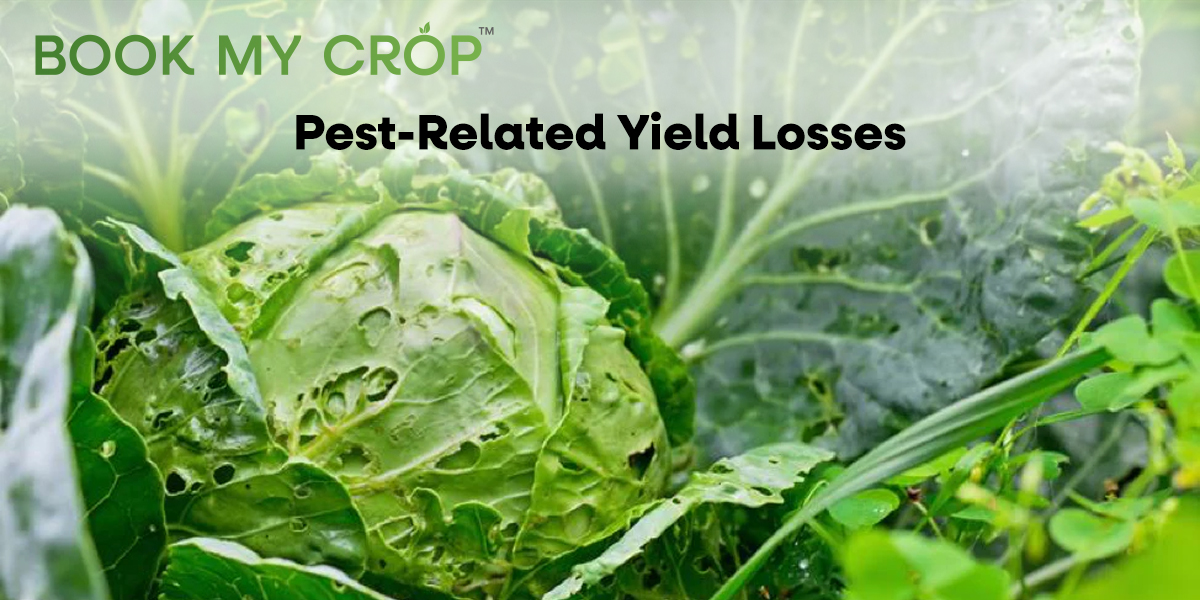
Farmers have had to compete with other creatures, such as insect pests, pathogens, weeds, and wildlife, to ensure food security ever since the beginning of agro-ecosystems about 10,000 years ago. These "biotic" (i.e. living) factors that contribute to crop loss can be just as harmful as "abiotic" (i.e. nonliving) stressors like drought, extremely high or low temperatures, nutrient deficiencies, and fluctuating irradiance, and they frequently act in concert to significantly reduce crop production.
Through a variety of pest management techniques, including biological, cultural, and chemical controls, such crop losses can be reduced. The article that follows looks at how pests affect crop production losses as well as ways to lessen their effects.
How Do Crop Pests Lead to a Loss in Yield?
Every pest has a different method of attack, whether it is a vine borer tunneling through a squash stem, a fire blight canker girdling an apple tree, or a deer destroying a soybean stand.
Pests generally lower crop output in a few ways, which are grouped according to their effects:
- Reducers of plant biomass and population, such damping-off diseases, frequently strike field crops the most when they are first established.
- Viral, bacterial, and fungal photosynthetic rate reducers affect a plant's capacity to absorb carbon dioxide at the cellular level.
- Pathogens known as leaf senescence accelerators are responsible for the early death and falling of leaves.
- Weeds and diseases that shade crops or damage leaf tissue, limiting photosynthesis, are examples of light stealers.
- Assimilate sappers invade plant cells or directly steal nutrients from crops via their sucking mouthparts. These organisms include diseases, arthropods, and nematodes.
- Unsurprisingly, tissue consumers consume plant components, including the roots, reproductive tissues, and foliage, as do chewing mammals and necrotrophic infections.
- Turgor reducers, which include root rots, wilt diseases, and root feeders, affect a plant's capacity to transfer water and nutrients through its tissues.
Understanding Potential Yield Losses and the Effectiveness of Crop Protection
Crop loss evaluations provide a simple comparison of the potential yield of a healthy crop and the actual yield of a diseased crop, assisting farmers in determining the need for an intervention, frequently in terms of cost.
Many important food crops can have yield losses of up to 70% in the absence of crop protection, with weeds causing the greatest losses (30%), followed by animal pests and pathogens (23%), and then diseases (17%). According to the FAO, pests cause 20–40% of yield losses worldwide on average, costing the global economy $290 billion in total.
Of course, crop loss statistics differ greatly from nation to nation and from crop to crop. For perennial crops like stone fruits and apples, up to 5% production losses are typical in the Netherlands, whereas a coffee crop in Brazil may experience losses of up to 45%. Agricultural research emphasizes models that take a few parameters into account, from qualitative crop injuries to quantitative losses, from pre- to post-harvest damage, despite the fact that crop loss assessments are notoriously difficult to execute.
Although crop protection effectiveness varies from pest to pest, on average it only accounts for 5-8% of a farmer's total output expenditures. In general, weed control results in yield improvements of 74% compared to 32% and 39% for animal pest and plant disease management, respectively. Additionally, it is believed that crop protection practises are more successful in preventing 53-68% of production losses in cash crops compared to 43-50% for food crops.
Of course, the impact of pests on crop production will increase as trade, climate change, and biodiversity losses increase. Despite varying predictions, some data claim that every 1 degree rise in global temperatures will result in a 10–25% increase in crop losses due to pests.
Strategies for Pest Management
The term "Integrated Pest Management," or IPM, refers to a system of pest management concepts that integrates knowledge from various fields, including nematology, weed and insect research, plant pathology, and epidemiology.
On the one hand, IPM recognizes the value of chemical pest management, such as fungicides and insecticides, particularly when acceptable pest levels have exceeded a certain "action threshold" of economic loss. IPM, on the other hand, prioritizes the integration of various, non-chemical techniques within a pest control regime and promotes monitoring and prevention above all else. A programme for integrated pest management might include:
Physical evaluations: Exclusion of pests through cultivation, mechanical weeding, obstacles, traps, etc.
The biological removal of pests: Bringing in predators, creating habitat for predators already there, etc.
Cultural customs: Crop rotations to lessen the prevalence of pests; adjusting planting and harvest dates based on the life cycles of the pests; choosing cultivars that are resistant to pests; etc.
Chemical methods: Growth regulators, pheromones to control pest movement, insecticides, fungicides, and herbicides, among others.
When to safeguard crops
Farmers must reduce agricultural yield losses to acceptable levels because it can be very difficult to completely manage a pest once it has invaded a plant.
Control measures can be implemented before the pest attack, when ideal weather circumstances present themselves, right away after the pest attack, or at the advised economic threshold, depending on the pest and the locality.
Nevertheless, preventing problems before they arise is preferable to fixing them after they arise, and acts that increase plant productivity and crop yields can also promote crop health. Such actions consist of:
Fertilization:
Plants that are lacking in nutrients are more prone to disease. Plant health is helped by a balanced soil that has enough macro and micronutrients.
Pruning:
In addition to increasing airflow, which lowers disease-causing circumstances, pruning also gets rid of inoculum, or contaminated plant material, which can lead to further spread. During pruning, good hygiene is essential.
Weeding:
Of course, weeds can directly harm crops by competing for resources, but they can also harm them indirectly by transmitting heteroecious parasites (i.e. pests that require two hosts, such as leaf rust and certain insect pests).
Irrigation:
Irrigation is a crucial preventative pest management method because water stress makes plants more vulnerable to infections and pests. But some irrigation techniques, such overhead irrigation, can make diseases more common, and other water sources might spread inoculum.
Removing fields of crop residues:
Sanitation is a crucial method for halting the spread of diseases in the future.
Rotation of crops:
Rotating plant families on a certain field increases the soil's nutritional availability and reduces the occurrence of insect and plant disease populations.
Compared to their conventional counterparts, organic and integrated agricultural systems frequently give priority to preventative measures for pest management, utilizing physical barriers to exclude them (such as high tunnels, row cover), cultural strategies to limit pest incidence (such as cover crop rotations to suppress diseases in the soil), and biological measures to encourage natural pest control (e.g. releasing ladybugs to manage aphids). These techniques also reduce agricultural pollution while improving the sustainability of a production system.
Consequently, farmers must also plan their farms with phytopathology in mind, choosing the best possible conditions for production, such as sunny, open locations with low humidity and dew accumulation, suitable soil types, and adequate drainage systems. Nevertheless, farmers must routinely keep an eye out for factors that encourage the spread of the illness, including as excessive humidity, extremes in temperature, heavy precipitation, and drought.
Data on the weather and temperature are particularly useful for following the life cycle of a pest. Any IPM plan can benefit from using farm management software (or FMS) with weather forecasting, IoT, satellite images, and scouting capabilities.
 Share
Share


Latest Blogs
Agriculture has always been the backbone of India’s economy, su ...
26-Aug-2025
Nowadays, technology has become the backbone of modern farming.
21-Aug-2025
The agricultural sector has always been the backbone of India’s ...
21-Aug-2025
The agriculture sector in India has been the backbone of the na ...
21-Aug-2025
The agricultural landscape in India is undergoing a transformat ...
31-Jul-2025


